Running a Mining Workshop: Numbers to Put on the Whiteboard
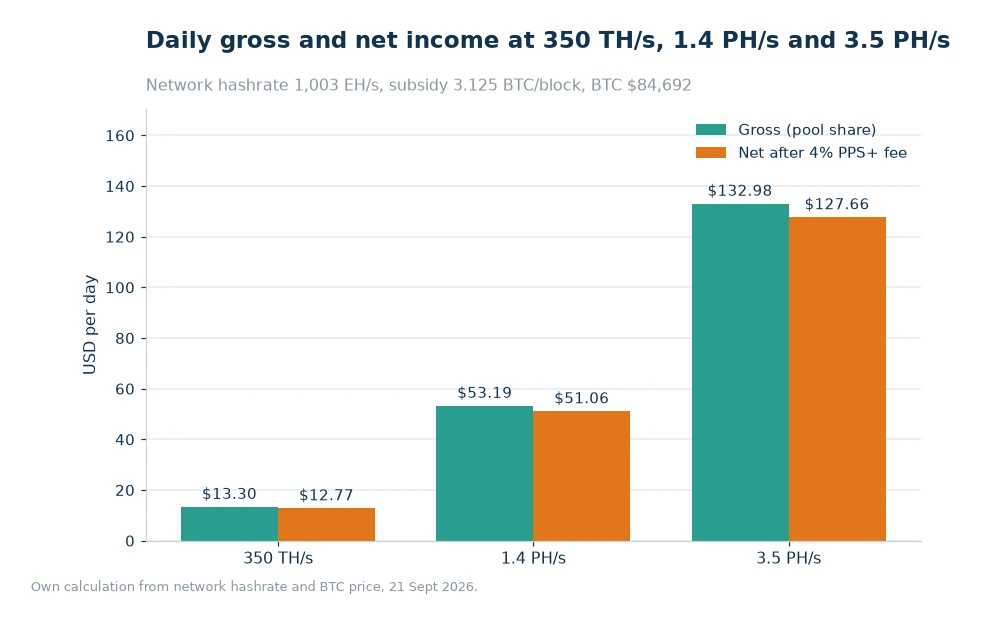
A ninety-minute beginners' workshop lives or dies on the four figures written before anyone arrives. At 350 TH/s the pool credits 0.00015701 BTC a day, which is $13.30 gross and $12.77 after the listed 4% on the block-reward component. A three-machine bench at 1.4 PH/s reaches $53.19 gross and $51.06 net. Put both on the board, then explain the gap.
Key takeaways
- Write 0.00015701 BTC, $13.30 and $12.77 on the board before the first slide; those three figures anchor the whole session.
- Under PPS+, the listed 4% applies to the block-reward component only, while the fee share runs at a listed 2%.
- Six confirmations is the wait under PPLNS, not under PPS+, and the difference decides when cash appears.
- Reserve the final twenty minutes for questions about cost; that is where the real objections surface.
Start with the room, not the protocol
Ask for a show of hands: who owns a machine, who has only read about them, who is here for a friend. The split changes the session. Owners want settlement timing and fee components. Readers want to know whether the whole exercise is worth the electricity. Friends mostly want a reason to stop worrying. Three groups, one whiteboard, and the board has to serve the least informed person without insulting the most informed.
Write the date in the corner. Every figure that follows belongs to 21 Sept 2026, when BTC traded at $84,692 and the network ran at roughly 1,003 EH/s. Nobody remembers a date on a slide, but everybody remembers one written in the corner when a figure later turns out to be stale.
A whiteboard diagram that survives a photograph
Draw one horizontal bar for a block reward and a second, much smaller, bar beside it for transaction fees. Label the first 4% listed and the second 2% listed. Underneath, draw a single combined bar for PPLNS at 2% listed. That is the entire diagram. It photographs well, it takes ninety seconds to copy, and it prevents the most common error in the room: treating PPS+ as a flat six percent.
Leave space to the right of the bars. Halfway through the session you will want to add a note about the six-confirmation wait, and a diagram with margin looks planned rather than improvised. If someone asks why the block-reward rate is higher, point at the bar and say the miner is not carrying pool luck there. That single sentence does more work than a slide.
Four rows you can hand out
Print the ladder below or copy it onto the board. The right-hand column is what a participant actually takes home, and it is the only column most of them will photograph.
| Setup | Hashrate | Daily gross | Daily net |
|---|---|---|---|
| One mid-size ASIC | 350 TH/s | $13.30 | $12.77 |
| Four-machine shelf | 1.4 PH/s | $53.19 | $51.06 |
| Small container | 3.5 PH/s | $132.98 | $127.66 |
Do not skip the middle row because it looks unglamorous. A four-machine shelf is the realistic end point for most people who leave a workshop excited, and showing it keeps expectations within reach of a spare room and a domestic circuit.
Nobody remembers the fee without a comparison
A percentage on its own is forgettable. A percentage attached to a dollar amount survives the walk home. Say the comparison out loud: at 350 TH/s the listed 4% is 53 cents a day, and over a thirty-day month that is $15.90 against a gross of $399.00. Put those two numbers side by side and the fee stops being an abstraction and becomes a line in a budget.
Then repeat the exercise at 3.5 PH/s, where the same listed rate costs $5.32 a day and $159.60 a month against $3,989.40 gross. The rate has not changed. The stakes have. That is the lesson worth ten minutes of the session, and it holds for every settlement scheme the audience will meet later. Print the fee schedule on the back of the handout so nobody has to take the numbers on trust.
Handing the next step to a neighbour
Workshops end with one person asking how to keep learning after the room empties. Point them at the ViaBTC Ambassador Program, which is built for exactly that handover: miners who run sessions, write guides and answer questions in their own language. The application route is on the same page under Apply for Ambassador, and it is worth mentioning only if someone in the room already does this work unpaid.
Be careful not to turn the closing ten minutes into a recruitment pitch. The room came for arithmetic. A single sentence pointing at the programme, offered after the questions have run dry, reads as help. The same sentence at minute five reads as a sales talk and costs you the audience.
Timing: ten minutes for fees, twenty for questions
Fees take ten minutes if the diagram is already on the board. Questions take twenty, minimum, and they are not optional. The most common one is not about percentages at all: it is about when the money arrives. PPS+ credits hourly against current difficulty. PPLNS waits for six confirmations and then shares the miner's slice across the last five difficulty rounds.
Keep a clock visible. A workshop that runs long does not produce more understanding; it produces people checking their phones. If the questions are still coming at the ninety-minute mark, offer to continue in a group chat and write the address on the board. That single act converts a one-off session into a small community, which is the outcome most organisers actually want.
Worked example
Walk the 350 TH/s rung through on the board, one line at a time.
- Convert to gigahash: 350 TH/s = 350,000 GH/s.
- Divide by the network: 350,000 ÷ 1,003,107,267,295 = 0.00000034892.
- Multiply by the daily subsidy: 0.00000034892 × 450 = 0.00015701 BTC.
- Convert to dollars: 0.00015701 × 84,692 = $13.30.
- Take the listed fee: 13.30 × 0.04 = $0.53.
- Subtract: 13.30 − 0.53 = $12.77.
Now scale it, which is the part that teaches more than the first four lines. A four-machine shelf at 1.4 PH/s is four times 350 TH/s, so 0.00015701 × 4 = 0.00062804 BTC, or $53.19 gross and $51.06 after the same listed rate. A 3.5 PH/s container is ten times the single rig: 0.00157012 BTC, $132.98 gross, $5.32 of listed fee and $127.66 net.
If a participant checks the multiplication on a phone and gets a figure a few satoshis different, that is the network hashrate quoted in round EH/s rather than to the last gigahash. Show the exact divisor once and the question answers itself. The point of the exercise is the shape of the arithmetic, not four decimal places of agreement.
Frequently asked questions
What should a workshop handout actually contain?
One hashrate ladder, one date, the two listed rates and a single worked line showing gross minus fee equals net; anything longer ends up in a bag and never gets read.
How do I explain the six-confirmation wait to beginners?
Call it a queue for certainty: PPLNS shares rewards once a block has six confirmations behind it, so the credit arrives after the chain has settled rather than at the hour the share was submitted.
Should the session cover altcoin mining?
Only if the room asks. One chain and one fee schedule is enough for a first session; the pool supports more than twenty coins, and a second workshop is a better place for that breadth than the last ten minutes of the first.
Close the room with one number
End on 0.00015701 BTC. It is small, it is exact, and it is checkable in under a minute on any phone. Participants who leave with one reproducible figure are far more likely to come back for session two than those who leave with a folder of slides. Hand out the Profit Calculator link alongside it so the next calculation happens at home, on their own hashrate, with their own power price in the next column.
Sources: the fee, calculator and ambassador pages at viabtc.com. Snapshot taken 21 Sept 2026: 450 BTC minted per day (3.125 × 144 blocks), 1,003 EH/s on the network, BTC at $84,692[1]. Handout numbers assume machines never stop. Published 24 Oct 2026.