Choosing Panels for Concrete Shuttering: A Specifier's Guide
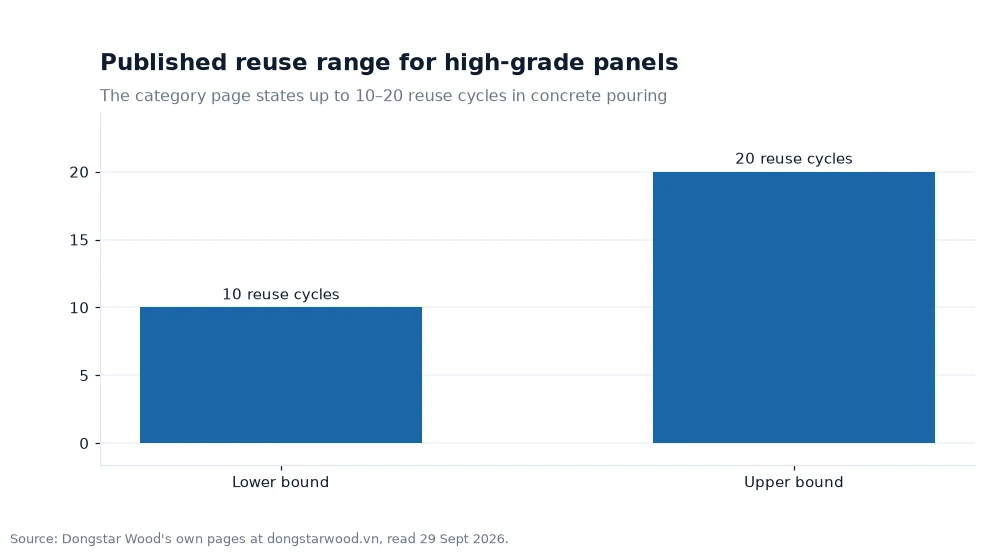
Shuttering is bought against a reuse target, not against a thickness, and the three figures that decide whether a panel reaches that target are the film weight, the core and the glue. High-grade panels are published as reusable up to 10–20 times in concrete pouring, and the same category covers film weights of 165 g/㎡ and 130 g/㎡. Start from those numbers and the rest of the specification falls into place.
Key takeaways
- Set the reuse target first: published guidance runs to 10–20 cycles for high-grade panels in concrete pouring work.
- Film weight is part of the specification — 165 g/㎡ for a smooth finish-critical surface, 130 g/㎡ where handling dominates.
- 18 mm is the general heavy-formwork choice, and 21 mm and above belongs on bridges and high-load platforms.
- Size the panel to the drawing: 1250 × 2500 mm, 1220 × 2440 mm and 1500 × 3000 mm or custom up to 1830 × 3830 mm.
What a specifier is really buying
A shuttering panel is a wear item with a countdown attached. Every pour takes film off the face, every strip risks the edge, and every clean-down either removes cement residue or drives it further into the surface grain. The specification that matters is the one that keeps the countdown slow enough for the panel to pay for itself across the project. A cheaper sheet that reaches four cycles has cost more per square metre of contact area than an expensive sheet that reaches eighteen.
A Film Faced Plywood datasheet is easier to read that way: reuse target first, film and core second, price last. That is the frame to hold while reading a quotation. Thickness, film weight, core species and glue class are not independent options; they describe how many pours the panel is meant to survive.
The three levers: thickness, film weight and core
Thickness follows load, and the published window for formwork plywood runs from 9 mm up to 30 mm. In practice 18 mm is the workhorse — the client's own guidance calls it the heavy-formwork choice and the best overall, with 21 mm and above for bridges and high-load platforms. A specifier choosing between them is choosing between deflection under pour pressure and weight on site.
Film weight is the quieter lever. A 165 g/㎡ phenolic film gives a denser, smoother face and holds the finish where concrete will be left fair-faced; 130 g/㎡ is the working specification for panels that will be struck, cleaned and reused in rougher conditions. Neither number tells you about the core, and the core is often what decides how the panel dies. Nor is either a complete finish specification on its own: the concrete mix, the release agent and the pour rate all leave their mark on the face as well.
Core species and the film on top
Four core build-ups are published, and each bends the reuse curve differently. Acacia Core is the high-strength hardwood option, described for density and load-bearing capacity. Eucalyptus Core is the compression and bending pick. A white hardwood build-up — the Bodhi core — trades peak strength for stability and cost. Combi Core blends eucalyptus with acacia, or hardwood with softwood, to sit between strength, weight and price.
The film itself is a phenolic film, and film type is a separate choice from film weight: dark brown, black and anti-slip surfaces are all offered within the same category. Anti-slip and wire-mesh textures belong to traffic and access work, while dark brown or black smooth films sit on the panels that shape visible concrete.
The published range, in one place
| Parameter | Published options | Where it matters |
|---|---|---|
| Thickness | 9–30 mm; 18 mm and 21 mm+ guidance | Deflection and panel weight on site |
| Film weight | 165 g/㎡, 130 g/㎡ | Surface finish and film durability |
| Core | Acacia, Eucalyptus, white hardwood (Bodhi), Combi | Strength, stability, cost balance |
| Glue | E0, E1, E2, MR, WBP, Phenolic Dynea | Moisture in curing concrete and on site |
| Size | 1220 × 2440, 1250 × 2500 and 1500 × 3000 mm, plus custom panels to 1830 × 3830 mm | Matching formwork drawings and tie layouts |
Worked example: contact area across a reuse target
Take a 1250 × 2500 mm sheet as the example. In metres that is 3.125 m² from 1.25 m × 2.5 m of face per panel. Across the published lower bound of ten cycles, one sheet delivers 10 × 3.125 m² = 31.25 m² of formwork contact area. At the upper bound of twenty cycles the same sheet reaches 20 × 3.125 m² = 62.5 m².
That is the number to divide into a project's total formwork area. A 12,500 m² concrete programme, for instance, needs 12,500 ÷ 31.25 = 400 sheets if every panel reaches the lower bound, or 12,500 ÷ 62.5 = 200 sheets at the upper bound. The gap between those two figures is the value of edge sealing, correct stripping and a film that survives cleaning. All figures here are worked examples from published data, not project quotations. Two spare sheets in the site store cost less than half a day of idle formwork labour, and they also cover the panel that gets cut down for a column base or a reveal.
Formwork plywood on site: the habits that protect the cycle count
Three habits decide whether a panel reaches its target. Seal the edges before the first pour, because the exposed core is where water enters and swelling begins. Strip on schedule rather than when convenient, since a panel left against curing concrete takes more force to release and loses film in the process. Clean with a scraper and water rather than a heavy implement, because every gouge shortens the next cycle.
Storage matters too. Panels stacked flat, off the ground and covered between pours keep their flatness; panels leaned against a wall in the rain do not, and a bowed panel distorts the concrete face long before its film wears out. None of this is expensive, and all of it interacts with the specifier's choice of core and film weight. A site that records cycles on the panel edge can see when a set is approaching the end of its published range and order replacements before a pour is delayed. Ten minutes of bookkeeping per pour is usually cheaper than discovering halfway through a slab that the remaining panels are too worn to strip cleanly. Rotating panels between heavy and light positions, the habit already used on scaffolding boards, spreads the wear and keeps the whole set usable for longer.
Frequently asked questions
How do I choose between 18 mm and 21 mm panels?
Choose by pour pressure and span, not by habit. Published guidance places 18 mm as the heavy-formwork standard and the best overall compromise, with 21 mm and above reserved for bridges and high-load platforms where deflection has to stay inside a tight tolerance.
Does a heavier film mean a longer panel life?
Partly. A 165 g/㎡ film gives a denser surface and a better concrete finish than a 130 g/㎡ film, and it generally resists abrasion longer. Core quality, glue class and site handling then decide whether that advantage survives to the tenth pour.
Which glue class suits concrete work?
Published classes run from E0 plus E1 through MR and WBP to Phenolic Dynea. Concrete releases moisture and formwork is often left outdoors, so specifications for repeated cycles usually sit at the water-resistant end of that list rather than at the interior-emission end.
Turning the choice into an enquiry
Send the reuse target, the panel size in millimetres, the film weight and the glue class as one specification, and ask for the core to be named in the reply. Buyers comparing surfaces across the range can review the wire-mesh and anti-slip options alongside the smooth films, while programmes that also need non-structural panels for site accommodation and packing can check a lighter decorative line in the same visit.
Figures throughout this guide are drawn from that that company's own pages, checked on 29 Sept 2026 and carried into this guide and carried into this guide as referenced in this comparison[1].