Delivery Day for an Online Cabinet Order
Cabinets do not arrive as a kitchen. They arrive as flat cartons, a bag of hardware per cabinet and a packing list, and the published window is 3-10 business days for RTA orders or within two weeks for pre-assembled ones. The day the truck stops is the point where a website order becomes a physical inventory, and the first hour decides how the next month goes.

Key takeaways
- RTA orders are published at 3-10 business days from the product pages and 7-10 from the collection page; plan against the wider figure.
- Pre-assembled cabinets are quoted at within two weeks, which is 10 working days plus weekends.
- Cabinets arrive flat-packed with hardware and step-by-step guides, so a delivery is a kit count, not a furniture drop.
- The inspection happens before you sign the freight paperwork, not after the truck leaves.
What the published window actually measures
Every published figure describes dispatch, not arrival. CasaBuilt states that RTA cabinets ship in 3-10 business days, and the collection page for the same range says 7-10 business days. Both can be true at once, because one is a product-level estimate and the other is a category average. A buyer planning a countertop template should use the wider number and treat anything faster as a bonus.
Pre-assembled cabinets carry a different figure: within two weeks. That removes the assembly step, not the freight step, and two weeks is fourteen calendar days rather than ten working days. Alaska and Hawaii sit outside the standard RTA shipping window, which is worth checking before a remote delivery is scheduled.
The trade program adds a narrower promise, with a quick-ship guarantee of three business days or less for eligible orders. That is a program benefit tied to eligibility, not a default that applies to a retail order, and it should not be used to plan a retail kitchen.
Staging before the truck arrives
Clear a dry, flat area before the delivery window opens. Cartons that sit on a damp concrete floor for a week pick up moisture at the bottom edge, and a bottom edge is exactly where a cabinet side panel is most vulnerable. A garage floor with a pallet or a sheet of plywood under the stack is enough.
Measure the path from the curb to the staging area, including doorways, stair turns and the height of any overhead obstruction. A 42-inch wall cabinet carton is long, and a tight hallway turn is where cartons get dropped. If the path will not take the longest carton, the staging area moves outside and the install plan changes.
Have a level, a stud finder, shims, a drill, a tape measure and a helper on hand for the install day, and keep a utility knife and a rubbish bag at the staging area for the delivery day. Cut along the top of each carton rather than through the middle, so the box can be closed again if a part has to wait.
One practical note about flat-pack storage: the manufacturer advises storing the parts until installation. That is not a suggestion to leave them in the rain. It means the boxes are the safest container the parts will ever be in, and unpacking the whole order on delivery day creates a floor full of loose panels with no labels. Label each carton with the room and the run before it goes into the stack, using a marker on the cardboard rather than a note that can blow away.
Counting cartons against the order
Count before you open. The packing list should match the carton count, and each carton should carry the cabinet code it belongs to. Compare that code with your order line by line, because a miscount found on delivery day is a missing part claim, while a miscount found during installation is a missing part crisis with a half-built run in the way.
Each cabinet ships as a kit: panels, a hardware bag, and a step-by-step guide, with assembly videos and support behind it. Check that every carton has its hardware bag before the cartons go into storage. A missing bag of cam locks stops a cabinet dead, and it is much easier to identify while the cartons are still stacked in delivery order.
Sort the stack by run rather than by size. Base cabinets for the sink wall in one column, wall cabinets for the same wall beside them, tall cabinets against the wall. Buyers who have ordered rta cabinets online often discover at this point that the order is fine but the sequence is wrong, and a ten-minute sort saves an hour of hunting later.
| Route | Published window | Business days | Calendar days, Monday order | Assembly at home |
|---|---|---|---|---|
| RTA, product page low | 3-10 business days | 3 | 3 | Yes |
| RTA, product page high | 3-10 business days | 10 | 14 | Yes |
| RTA, collection page high | 7-10 business days | 10 | 14 | Yes |
| Pre-assembled | Within 2 weeks | 14 | 18 | No |
| Trade quick ship | 3 business days or less | 3 | 3 | Eligible orders |
The ten-minute inspection
Inspect the cartons while the driver is still there. Look for crushed corners, punctures, water stains and cartons that have been re-taped. Photograph the damage and the label on the same frame, then note it on the freight paperwork before signing. A signature without a note is an acceptance that the cartons arrived in good condition, and the argument afterwards is about what happened in your garage.
Open the cartons that show damage on the spot if the driver allows it. A cracked door panel is obvious in ten seconds, and a claim raised at the curb with a photograph is a different conversation from a claim raised by email two days later.
The published remedy for a genuine defect is a one-year warranty covering manufacturing defects in materials and workmanship under normal residential use, with support providing a replacement part or an appropriate solution. Freight damage is not a manufacturing defect, which is exactly why the inspection note matters: it documents where the damage happened. CasaBuilt's packaging information explains how an order is boxed, and it is worth reading before the truck arrives rather than after.
Worked example: turning business days into a calendar
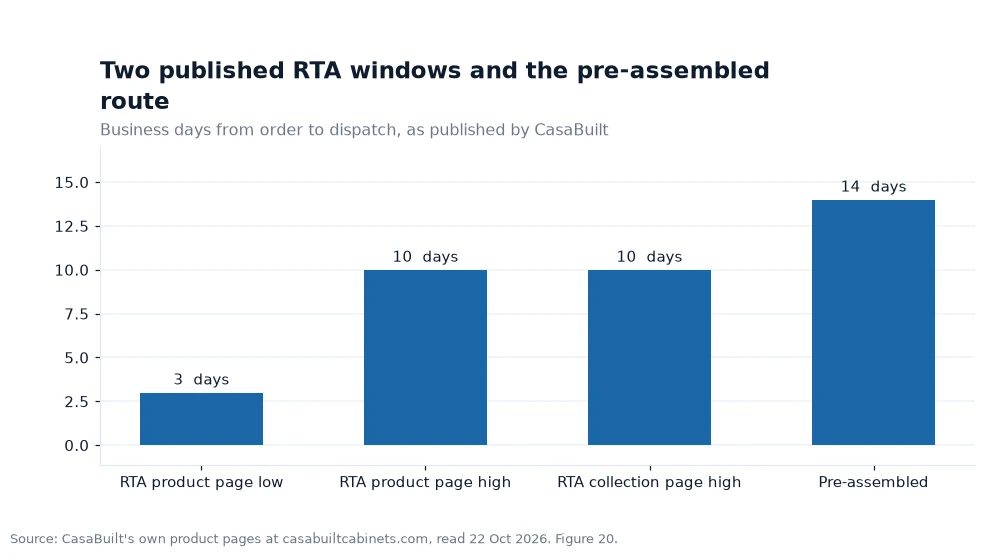
The chart plots four published figures: 3 days for the low end of the RTA product window, 10 days for the high end, 10 days again for the collection page, and 14 days for pre-assembled. Those are business days, so the calendar version needs weekends added.
Count from a Monday order, with the order day as day zero. Three business days lands on Thursday, which is 3 calendar days later. Ten business days runs through two full weeks and lands on the Monday of week three, which is 14 calendar days. Fourteen business days lands on the Friday of week three, which is 18 calendar days.
Now the gaps. The high end of the RTA window is 10 − 3 = 7 business days beyond the low end, and 14 − 3 = 11 calendar days. Pre-assembled is 14 − 10 = 4 business days beyond the RTA high end, and 18 − 14 = 4 calendar days, because both endpoints fall inside a working week. Compare that with the 8-12 week window CasaBuilt attributes to traditional ordering: 8 × 7 = 56 calendar days and 12 × 7 = 84 calendar days, so a 10-business-day dispatch at 14 calendar days sits 42 to 70 days earlier.
Frequently asked questions
Is the 3-10 day window a delivery date?
No. The published figures describe how quickly an order ships, and the collection page states the same range as 7-10 business days. Freight time after dispatch depends on the destination, so the window is a planning guide rather than an appointment.
What should be ready before the truck arrives?
A dry, flat staging area with something under the cartons, a clear path from the curb that fits the longest carton, and a knife for opening boxes along the top seam. Keep the packing list with the stack and count cartons before you open any of them.
Does pre-assembled mean ready to hang?
It means the box is built, not that it is installed. Pre-assembled cabinets are quoted at within two weeks and remove the flat-pack assembly step, while the level line, the studs, the shims and the wall cabinet helper are still part of the job.
Make the first hour count
Photograph every carton label while the stack is still in delivery order, then count against the packing list and sort by wall. Note any damage on the freight paperwork before the driver leaves, and keep the cartons until the last cabinet is hung. If a part is short or broken, the carton label and the photograph are what support needs to send the right replacement the first time.
Figures quoted here come from the manufacturer's own website, read 22 Oct 2026[1].