Common Challenges in Understanding sourcing fees and quotations
Sourcing proposals combine different kinds of charges and assumptions. Buyers can prevent budget surprises by itemizing provider work, supplier pricing, third-party expenses, payment triggers, and changes before comparing total cost.
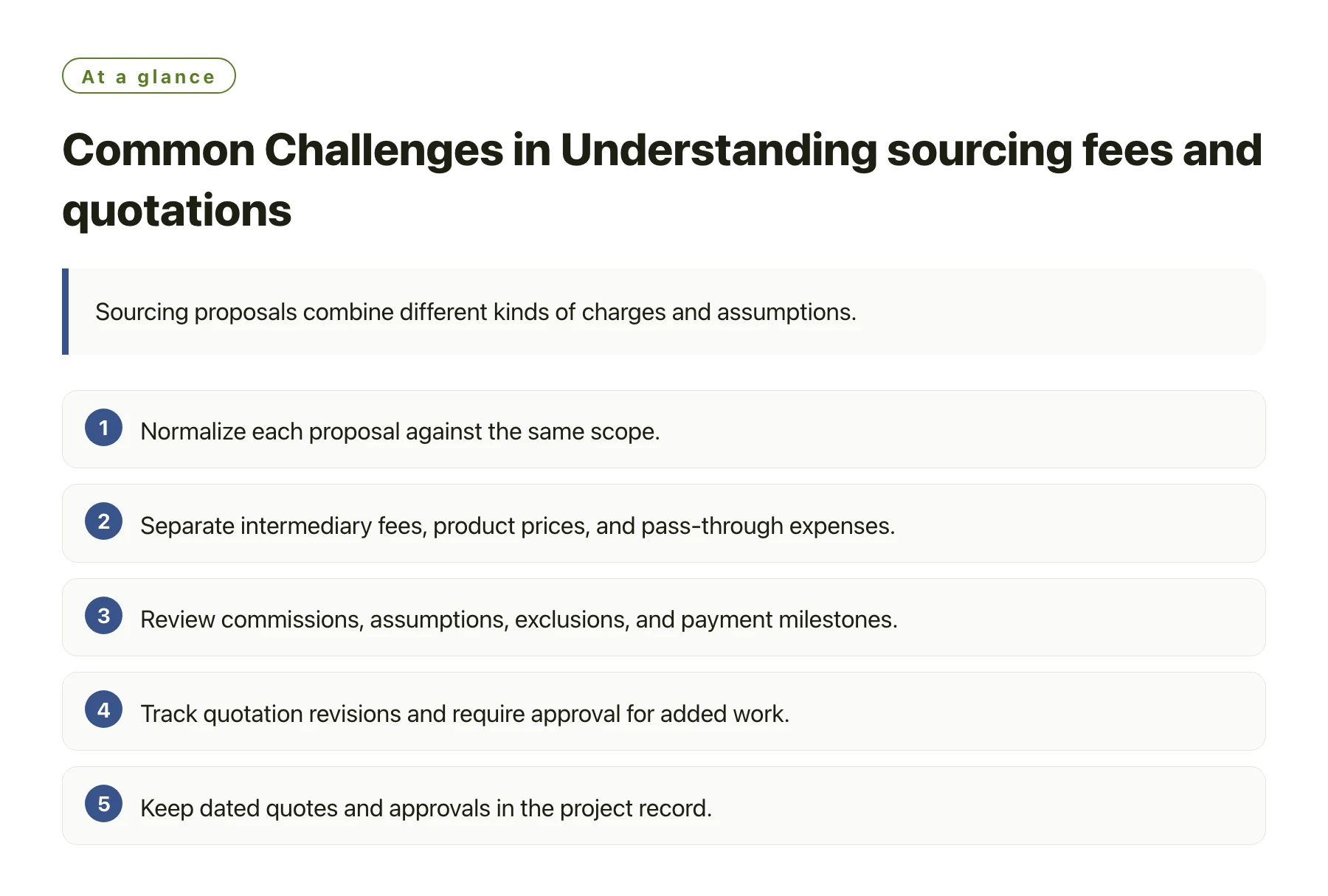
Key takeawaysNormalize each proposal against the same scope. · Separate intermediary fees, product prices, and pass-through expenses. · Review commissions, assumptions, exclusions, and payment milestones. · Track quotation revisions and require approval for added work. · Keep dated quotes and approvals in the project record.
A clear quotation makes the priced work and the unpriced risks visible. The buyer can then compare service value and supplier economics on a consistent basis.
1. Read the quote as a scope document
A sourcing quote is more than a price. It describes what the provider believes the assignment includes, how the work is charged, which assumptions apply, and what remains outside the fee. Start by checking the named contracting entity, quote date, validity period, currency, project reference, and the product or service covered. If any of these are missing, request a revised document before comparing totals.
Separate supplier product pricing from sourcing service charges and third-party expenses. A combined figure can obscure whether the intermediary fee covers discovery, quotation review, samples, visits, inspection coordination, or shipment handoff. Ask for itemized lines or a written schedule so later invoices can be matched to agreed work.
2. Compare fee models on the same workload
A fixed project fee is easier to budget when scope and deliverables are stable. Hourly billing can fit work with uncertain effort but needs rate bands, time records, and approval limits. A per-supplier or per-visit fee may suit a bounded activity. A commission based on order value can scale with purchasing but may create incentives different from a buyer’s preferred sourcing decision.
Calculate each option against the same expected workload and transaction value. Include minimum charges, currency conversion, bank fees, taxes where applicable, rush fees, cancellation costs, and reimbursable expenses. Then run a low, expected, and high scenario. A single projected total can hide the effect of larger orders or additional supplier rounds.
3. Look for the assumptions beneath the number
Ask what volume, order count, supplier count, visit frequency, product complexity, and response time the quote assumes. Confirm whether the price covers one product or a family of variants, one factory or multiple facilities, and one sample cycle or repeated revisions. If the supplier’s answer changes the workload, ask for the cost impact before approving the work.
Clarify what “included” means in operational terms. A visit fee might exclude travel, interpretation, report translation, or a follow-up. A quotation review could cover a side-by-side table but not engineering validation. Record each assumption next to the amount it affects so the buyer can make an informed tradeoff.
4. Identify exclusions and pass-through costs
Request a list of excluded services such as laboratory testing, product design, regulatory review, customs brokerage, freight booking, warehousing, sample purchase, courier, travel, translation, or third-party audit. If the provider arranges an external specialist, determine whether the buyer contracts directly or pays through the provider, and what documentation is supplied.
Agree how pass-through expenses are approved and substantiated. Set a threshold requiring written approval, require receipts or supplier invoices, and specify whether a coordination markup applies. For foreign-currency expenses, agree the exchange-rate date and who bears bank charges. These details prevent small expenses from accumulating into an unplanned project cost.
5. Examine the commercial terms
Check payment triggers, deposits, milestone definitions, invoice timing, late payment terms, tax treatment, bank beneficiary, refund conditions, and termination rights. Link each milestone to an identifiable deliverable or service period. If payment is due upon “completion,” define what completion means and how unresolved items are handled.
Verify that payment instructions match the contracted party. The U.S. Department of Commerce recommends due diligence when evaluating foreign business partners; buyers should verify identity and payment details using independently confirmed contact channels, especially after a change request. [1] Keep approvals and account confirmations in the project file.
6. Understand commissions and other incentives
Ask whether the intermediary receives a commission, rebate, referral payment, supplier-paid fee, or other benefit connected to a factory or order. Clarify the calculation base, timing, disclosure method, and whether supplier compensation is separate from the buyer’s fee. The existence of another payment does not by itself establish a problem, but undisclosed incentives make recommendations harder to assess.
Decide what transparency is needed for the project. The buyer may require disclosure for every shortlisted factory, direct supplier quotations, or written approval before a partner accepts another payment. State whether the sourcing partner may negotiate only or may commit the buyer to price, quantity, or terms. Keep those authority limits separate from the fee schedule.
7. Reconcile quotation revisions
Give every quote a revision date and retain superseded versions. When the supplier changes quantity, material, packaging, delivery basis, or lead time, identify which line changed and why. Compare revised totals to the same specification and commercial assumptions; a lower number may reflect a substituted component or removed service.
Ask the provider to show supplier price separately from service fee and logistics estimates, with estimates clearly marked. Confirm whether optional items are included in the grand total. A short variance table should identify old value, new value, reason, evidence, and buyer decision so the team does not rely on an outdated PDF or message thread.
8. Compare value and risk, not only the lowest fee
Evaluate the deliverables and evidence behind each proposal: supplier screening method, quote normalization, communication cadence, visit records, issue escalation, and handoff documents. A higher fee may cover work that otherwise falls on the buyer’s team; a low fee may be suitable for a narrow task when the buyer already has the missing capabilities. Compare like-for-like before reaching a conclusion.
The U.S. Department of Commerce notes that due diligence helps organizations evaluate foreign business partners; apply proportionate checks to the service provider as well as factories. Ask for relevant references, redacted report examples, contracting details, and an explanation of how conflicts are managed. Keep unresolved concerns visible instead of burying them in a score.
9. Set a change-control rule
Define what counts as additional work: new product families, extra suppliers, repeated sample rounds, unplanned factory travel, urgent schedule changes, or expanded inspection scope. Require a change request that explains added tasks, fee, expenses, timeline, and deliverable before work proceeds. Name the person on the buyer side who can approve it.
For an urgent exception, agree in advance on a small authorization threshold and require a prompt written record. This keeps the project moving while preserving cost control. Do not assume that a broad “reasonable expenses” clause gives a clear limit for travel, testing, or rush work.
10. Turn the accepted quote into an operating record
Before signing, summarize the chosen fee model, scope, exclusions, assumptions, incentive disclosure, payment milestones, approval authority, and reporting cadence. Attach the quote revision and the buyer’s sourcing brief to the agreement. Confirm that the provider’s invoice will identify project and service period so finance can reconcile it.
Buyers evaluating Shanghai JS Sourcing can use this checklist to compare service proposals alongside supplier quotations. Ask for current terms directly, keep product and service charges distinct, and preserve the original and revised documents with dated approvals. A clear record makes later changes easier to price and review.
Sources
Frequently asked questions
What should be itemized in a sourcing quotation?
Separate provider fees, supplier product prices, third-party charges, travel, samples, logistics, taxes, currency, and exclusions.
Is a commission-based sourcing fee always a conflict?
Not automatically, but the calculation and any supplier payment should be disclosed so the buyer can evaluate incentives.
How can I avoid unexpected service charges?
Define included activities, expense thresholds, change approval, and payment triggers in writing before the assignment begins.
Should the cheapest sourcing quote decide the selection?
Compare scope, evidence, exclusions, and total expected cost first; a low fee may cover a narrower service.